- Home
- Steam Resources
- Steam Theory
- Vacuum Steam Basics
Steam Control
Vacuum Steam Basics
What causes steam to blow out so strongly?
Steam is commonly thought of as blowing out vigorously when a valve is opened and released to the atmosphere. It is also blown out from valve packing and pinhole leaks. What does this phenomenon mean? The answer is simple: steam has a higher pressure than atmospheric pressure.
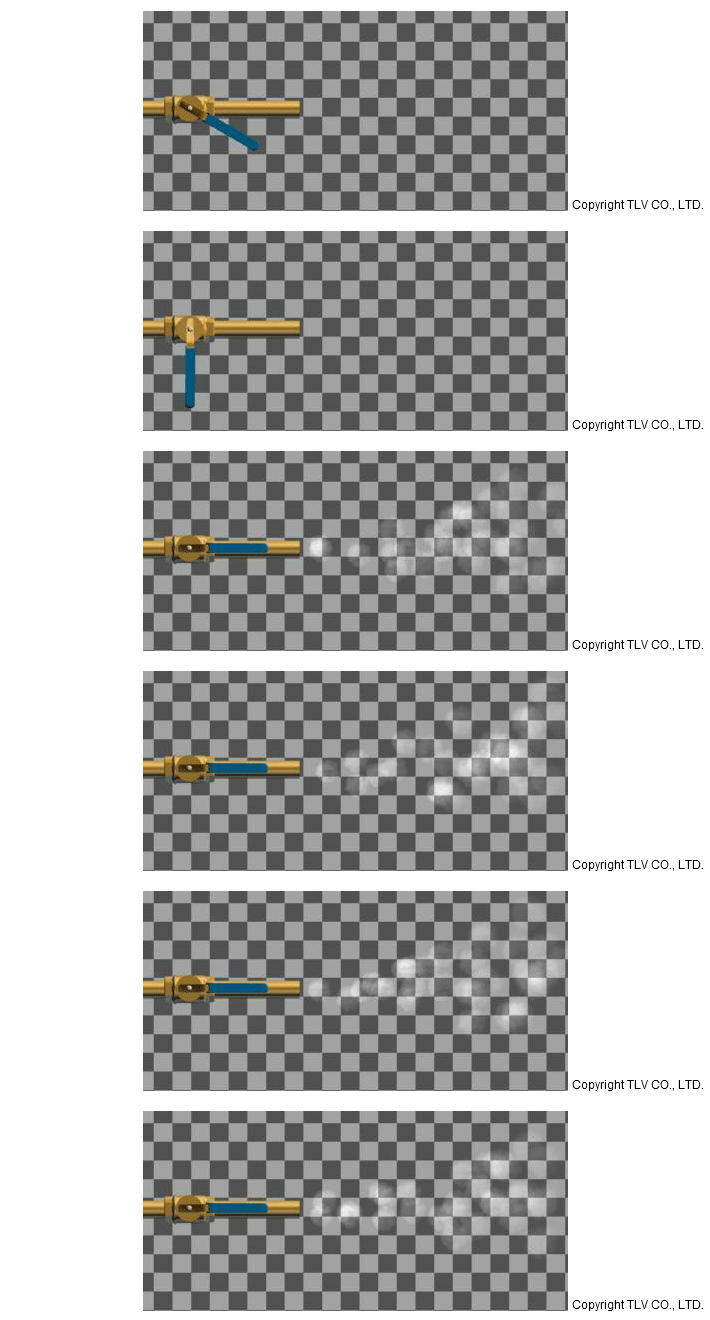
So, is the pressure of steam always higher than atmospheric pressure? Actually no, it is possible to generate and use steam below atmospheric pressure: vacuum steam.
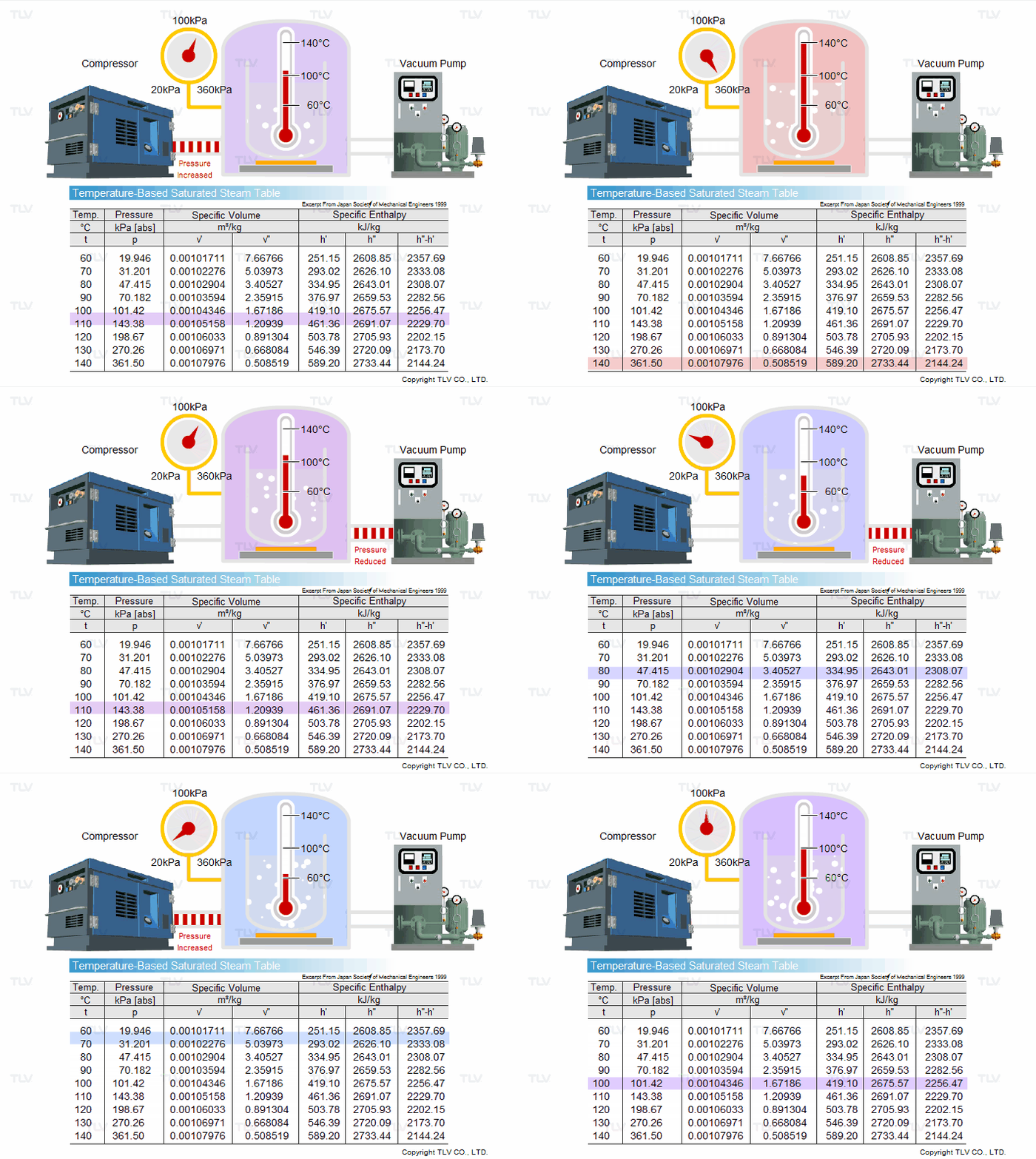
It is common knowledge that water has a lower boiling point at higher altitudes. In other words, at lower pressures, water boils at a lower temperature. Similarly, steam generated at pressures below atmospheric pressure will have a temperature lower than 100°C [212°F].
Low-Temperature Saturated Steam (Vacuum Steam)
Referring to a saturated steam table, we can see that the pressure of saturated steam at 100°C [212°F] is 101.42 kPa abs [14.7 psia], which is near atmospheric pressure. The steam table also shows data for steam at temperatures below 100°C [212°F].
Temperature Based Saturated Steam Table
| TEMP. | PRESS.(GAUGE) | SPECIFIC VOLUME | SPECIFIC ENTHALPY | |||
|---|---|---|---|---|---|---|
| °C | kPaG | m3/kg | kJ/kg | |||
| T | P | Vf | Vg | Hf | Hfg | Hg |
| 60 | -80.05 | 0.00101711 | 7.667 | 251.2 | 2609 | 2358 |
| 70 | -68.8 | 0.00102276 | 5.039 | 293.1 | 2626 | 2333 |
| 80 | -52.58 | 0.00102904 | 3.405 | 334.9 | 2643 | 2308 |
| 90 | -29.82 | 0.00103594 | 2.359 | 376.9 | 2659 | 2282 |
| 100 | 0.093 | 0.0010435 | 1.672 | 419.1 | 2256 | 2676 |
| 110 | 42.051 | 0.0010516 | 1.209 | 461.4 | 2230 | 2691 |
| 120 | 97.340 | 0.0010603 | 0.8913 | 503.8 | 2202 | 2706 |
| 130 | 168.93 | 0.0010697 | 0.6681 | 546.4 | 2174 | 2720 |
| 140 | 260.18 | 0.0010798 | 0.5085 | 589.2 | 2144 | 2733 |
| 150 | 374.78 | 0.0010905 | 0.39250 | 632.3 | 2114 | 2746 |
Steam below 100°C [212°F]
Saturated steam at temperatures below 100°C [212°F] has a pressure below atmospheric pressure, approximately 101.42 kPa [14.7 psia]. While not widely known or utilized, vacuum steam does exist and excels in certain heating applications, as we will discuss later.
How to Create Vacuum Steam
Since saturated steam with a temperature below 100°C [212°F] can only exist in a vacuum state below atmospheric pressure, it is necessary to start by depressurizing the steam system itself, from piping, heat exchanger, steam trap and condensate recovery system, to below atmospheric pressure.
There are several ways to generate a vacuum, but the most common is to use an electric vacuum pump in a vacuum steam system.
Characteristics of Vacuum Steam
Vacuum steam requires some additional work and equipment to use, but when it is saturated, it offers the same advantages as saturated steam above atmospheric pressure. In other words:
- Rapid even heating through latent heat transfer: Improved product quality and productivity
- Pressure can control temperature: Temperature can be quickly and precisely established
- High heat transfer coefficient: Smaller required heat transfer surface area, enabling reduced initial equipment outlay
Steam is an excellent heat medium even at lower temperatures.